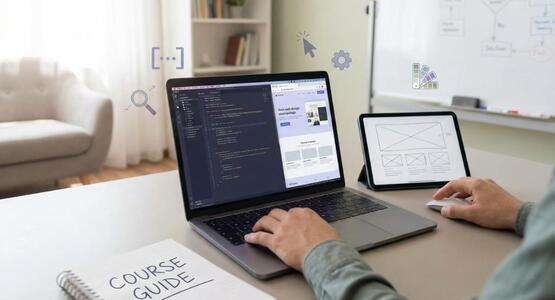
In a rapidly digitising world, more businesses than ever rely on well-designed, high-performance websites to reach customers and grow their brand. For those keen to build a career that blends creativity and technical skill, learning how to design and develop websites can open many doors. In this article I explore what a website design and development course actually offers, why those skills matter today, and how you can begin — even if you are a complete beginner. My aim is to give you an honest, deep and practical view of what it means to learn website design and development without sales hype.
If you have ever wondered how websites work behind the scenes, what you need to learn to build one, or whether a full course is worth the time and effort, keep reading. This guide will help you understand the fundamentals, the challenges, and the opportunities — in plain language.
The pace of technological change moves fast. Many businesses that once relied on in-person customers are now reaching out online. Whether it is a small local shop or a multinational firm, having an engaging, well-designed website is no longer optional — it is essential. This shift creates strong demand for people who can build websites that look good, perform well, and provide a seamless user experience.
A website is often the first point of contact between a business and a customer. If a site is poorly built, slow, confusing or outdated, a potential customer may simply look somewhere else. On the other hand, a professional and user-friendly site can build trust, reflect brand values, and convert visitors into customers. By learning website design and development you equip yourself with the tools to deliver these outcomes.
Additionally, the role of a web developer or designer is flexible. Once you master the relevant skills, you can work on client projects from anywhere — offering services globally, freelancing, or working for a company. You are not tied to a physical location. For many, that flexibility is a key advantage in today’s world.
Moreover, having technical skills like HTML, CSS, JavaScript, a grasp of design principles and knowledge of how front-end and back-end work together gives you more control over digital projects. It lets you understand both how a website looks and how it functions. In short, web design and development empowers you to build something real — your own websites, or for others — from the ground up.
Because of this growing demand and the value of such skills, a full structured website design and development course becomes a very useful and often necessary path. A good course can accelerate learning, giving you a systematic understanding of all important concepts and helping you build real-world projects rather than just reading about theory.
If you decide to learn web design and development in a structured setting, there are certain core areas your course must cover to ensure you walk away with meaningful skills. A strong course should begin with the basics and gradually build your knowledge so that you can handle real projects with confidence.
At the foundation, you need to learn HTML5. This is the standard markup language used to structure and present content on the web. Understanding HTML properly helps you create clean, semantic web pages, which form the skeleton of any site. Alongside HTML, Cascading Style Sheets (CSS) are essential. CSS allows you to control how elements on the page look — layout, typography, colour, spacing — everything that affects how the site feels visually.
Once HTML and CSS are clear, moving into more advanced aspects such as responsive design, layout techniques, and grid or box models is important. These allow you to build websites that work across devices such as desktop, mobile or tablet. A thorough course should help you understand visual design principles: how to choose colours, fonts, spacing, alignment, and how to use images or graphics so the site looks professional and easy to use.
Next comes interactivity. That is where you learn JavaScript and, optionally, frameworks or libraries such as jQuery or Bootstrap, depending on the course. These tools let you add dynamic behaviour — drop-down menus, image galleries, contact forms, interactive slideshows, lightboxes, form validation, animations and more. Such interactivity improves user experience and gives websites depth beyond static pages.
Behind the scenes, back-end knowledge often becomes important — especially if you want to handle full websites rather than static pages. Learning server-side programming, databases and how front-end and back-end communicate becomes valuable. A course that includes back-end training (for example using a language like PHP) can help you build complete, functional websites, content management systems or web applications.
Finally, a good course will combine both design and development — teaching you not just how pages should look, but how they should work. It will emphasise the balance between aesthetics and usability, credibility and performance. Such a holistic course prepares you to meet real-world client or employer needs.
Completing a comprehensive course in website design and development can open many pathways. First, you can build websites for yourself. This might be for a personal portfolio, a blog, a small business, or any project that needs an online presence. Being able to start and maintain your own website gives you independence and control.
Second, you can work for clients. Many small businesses and startups need websites but cannot hire large agencies. As a capable web designer/developer you can offer freelance services. With your knowledge, you can deliver affordable, professional websites, sometimes with added services such as maintenance or updates. This often translates into a good income stream — especially if you deliver quality work consistently.
Third, you can work for established firms or agencies. Large companies value employees who understand both design and technical aspects of web development. Your skill set may qualify you for roles as front-end developer, web designer, or full-stack developer depending on your learning path.
Fourth, you gain lifelong skills. Web standards and technologies evolve, but core principles remain. Once you learn HTML, CSS, JS, and basic design sensibilities, adapting to new libraries, frameworks or tools becomes much easier. That foundational knowledge stays with you.
Finally, having web design and development skills helps you understand digital marketing better. A website is often a foundation for marketing campaigns, SEO, user engagement, and conversion tracking. Understanding how a site is built gives you insight into performance, user experience and technical SEO — highly valued in the digital world.
When starting a course, you may wonder what a realistic learning path looks like. An effective course should begin with simple concepts and gradually increase in complexity. The early period should focus on building competence in HTML and CSS, making sure you understand how to structure pages, how styling works and how to combine elements into a coherent layout.
After basics, adding design theory is valuable. You should learn UI and UX fundamentals: how to design interfaces that are intuitive and appealing, how to choose typography, colours, spacing. You should experiment with converting design templates (for example from an image or wireframe) into actual web pages. This process helps bridge design thinking with coding skills.
Next, you move into interactive front-end skills: JavaScript, jQuery or other libraries. You learn how to create dynamic elements like image galleries, pop-ups, contact forms, responsive navigation menus. Such features are common on professional websites and improve user engagement.
Then you may move to tools and deployment: using editors or IDEs, learning how to upload a website to a server, working with FTP clients, managing project files. Understanding how to move from local development to a live website is crucial for real-world work.
If the course includes back-end training, at this stage you might begin learning server-side programming such as PHP, database interaction, data submission via forms, user login, or dynamic content generation. This enables you to build functional web applications or dynamic websites rather than only static ones.
Alongside all this, the course should support practical, hands-on learning. Rather than only teaching theory, a good course gives assignments, real projects — even live websites. This kind of real work builds confidence and helps you learn to solve real problems. It also creates something you can show as part of your portfolio once you complete the course.
In many cases, design and development are handled by separate people: designers focus on how the site looks, developers focus on how it works. Yet, a professional who understands both sides — the visuals and the code — is extremely valuable.
When you have design sense along with coding skills, you are able to make decisions that balance user experience, aesthetics and technical performance. You understand what a user sees as well as how that design will behave in different browsers, devices or conditions. You can foresee layout issues, performance bottlenecks, or compatibility problems — and solve them in advance.
Such holistic understanding helps you build not just websites but meaningful web experiences. It also places you in a stronger position when working with clients or employers who want quality along with reliability.
Many people hesitate before enrolling in a full website design and development course. Some worry it could take too long, or that it might be too technical or too abstract. Others fear that once they learn, they might not get enough opportunities. These concerns are valid, but they can be addressed if you choose wisely.
If you are new, learning to code may initially feel challenging. It might take time to get comfortable with syntax, layout concepts, responsive design issues, and JavaScript. But if the course starts from the basics and progresses gradually, with hands-on projects and patient guidance, the learning curve becomes manageable.
Time is another factor. A thorough course may take many months to complete. You need commitment and consistency. Learning by doing is the key. Setting aside regular time to practice, building small projects, experimenting with layout and functionality — that is how you master web design and development.
Another concern is job opportunity. The industry can be competitive. But demand for skilled web designers and developers remains strong. What matters most is the quality of your work. A strong portfolio, practical skills, and ability to deliver reliable websites can set you apart.
Before enrolling in any course consider checking what the syllabus covers: whether there is front-end and back-end training, real-world project work, design fundamentals, deployment processes, UX/UI basics. Also check whether the trainers have industry experience and whether there is support for students to build portfolios or get job placements.
If you are exploring options, these are the questions to ask yourself. What exactly do you want to do after learning — build your own website, freelance, join a company, or build web applications? Your goal will shape what you need to learn. For simple website development or static sites, focusing on HTML, CSS, design fundamentals and basic JavaScript may suffice. For dynamic sites or web applications you may need back-end knowledge as well.
Also think about your learning style and schedule. Some people prefer full-time immersive courses, others part-time learning alongside their job or education. Choose a course that gives you flexibility if you need it, and offers enough support so you do not get lost.
Look for practical training. Theory alone will not help you build real websites. Projects, hands-on exercises and actual deployment experience are essential. Having a real project — even if small — in your training portfolio can make a big difference when you seek jobs or freelance clients.
Lastly, check how updated the syllabus is. Web standards and technologies evolve. A course that still teaches outdated tools may not prepare you well. Make sure the course covers modern web standards, responsive design, and current best practices.
Over time, having web design and development skills gives you flexibility. You may start by building simple websites. As your experience grows, you can take on more complex projects — dynamic websites, e-commerce sites, web applications, custom solutions. This progression depends on continuous learning and practice.
With each project, your understanding deepens — of design, code, user behaviour, performance optimisation, accessibility, and more. These are skills that do not just help in building websites but also in understanding how web technology interacts with marketing, business growth and user engagement.
You may also explore related fields easily. Once you understand front-end and back-end, moving into mobile app development, web app frameworks or digital marketing becomes more natural. A versatile foundation gives you choice.
Over time, a strong portfolio of websites, a track record of successful projects, and a habit of learning new tools or techniques can position you well for freelance success. Many people working independently or remotely are able to earn well once they accumulate enough experience and reputation.
Learning website design and development is an investment — in time, effort and practice. It is not instant. It requires patience and willingness to experiment, to make mistakes, and to learn from them.
Yet the payoff can be significant. You gain the ability to build real, functioning websites; you can work for clients or employers; you have the flexibility to work remotely; you acquire skills that remain relevant long into the future. And you gain the satisfaction of seeing your code turn into something visible and useful.
If you are curious about how the web works, if you like combining creativity with logic, or if you want a career that grows with you and offers flexibility, then a full website design and development course can be a powerful starting point.
Overwhelmingly, the value lies not just in learning individual tools, but in mastering the entire workflow — from design concept to final live site. If you approach learning with commitment, clarity and focus, you can build a solid foundation that carries you far.
Let this article be your starting point for understanding what it truly means to learn website design and development. Whether you are a complete beginner or someone looking to upskill, the journey is challenging but rewarding. Good luck in your exploration.

From Student to Developer: The Power of Programming Training in Gaighata

Career Opportunities After Completing a Graphic Design Course in Kalasima

From Student to Digital Marketing Professional: How Digital Marketing Courses in Bongaon Can Transform Your Future
How Learning Python in Nahata Can Open Doors to Global Tech Opportunities

Why Students in Nahata Are Choosing Graphic Design as a Career in 2026
How a Mobile App Development Course in Kalasima Prepares You for the IT Industry
Graphic Designer Course in Helencha to Start a Successful Graphic Design Career

How Students Can Prepare for Job Opportunities for Graphic Designer in Kalupur

Programming Careers in Kolkata: What Happens After You Learn to Code?

Top Career Growth Opportunities for Digital Marketing Professionals in Gaighata
Career Opportunities After Learning Ionic App Design in Gopalnagar

Career Growth Potential Through IT Job Opportunities in Thakurnagar

Faculties from Mobile App Development Institute and Web Designing Institute work hand in hand as these are some of the essential requisites that a digital marketer needs to understand.
Sources